
Pupils from Ysgol Gŵyr, Maesteg School and Olchfa School joined the REMODEL team for a day of practical activities designed to introduce different areas of engineering, simulation and design. The event was the first outreach event organised by REMODEL, and the project hopes it will be the first of many opportunities to engage young people with engineering research.
International Women in Engineering Day is an important opportunity to celebrate the contribution of women engineers and to encourage more girls to consider engineering as a future career. Women remain significantly underrepresented in the engineering and technology workforce, making up around 17% of engineering and technology roles in the UK, compared with 56% of other occupations. Reflecting the 2026 theme, Engineering Intelligence, the event aimed to show pupils that engineering is not only technical, but also creative, collaborative and rooted in solving real-world problems.
The day began with an introductory talk led by Dr Jennifer Thompson and Professor Oubay Hassan, setting the scene for a day focused on simulation, design and practical engineering. Pupils were introduced to the role of computer simulations in modern engineering, including how they can help engineers test ideas, explore different designs and better understand how real systems may behave before anything is built.
Pupils then rotated through a range of activities across Bay Campus, giving them the chance to experience several different aspects of engineering.
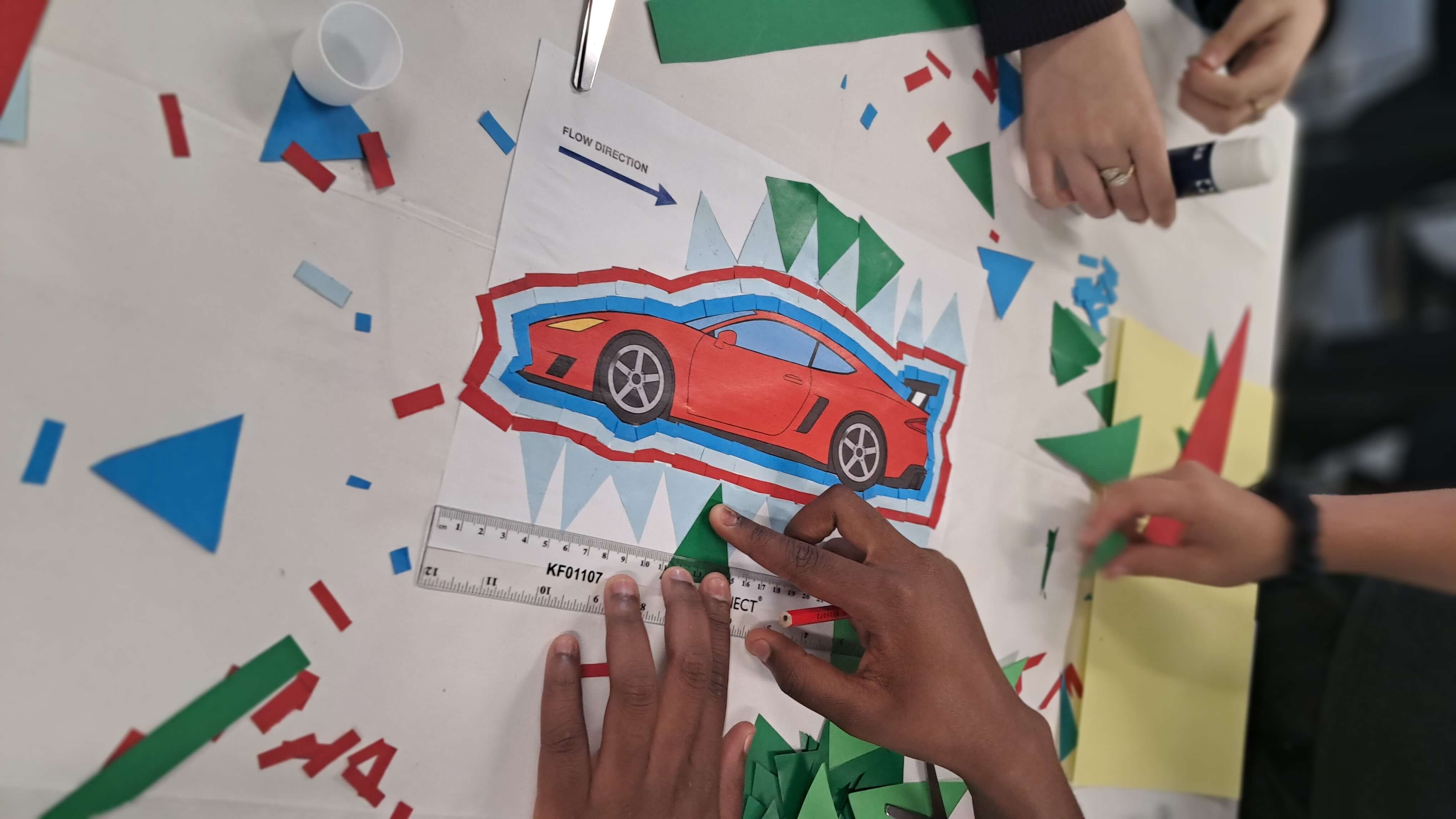
In one activity, pupils explored computational meshing with Dr Callum Lock and Dr Xi Zou. They learned what makes a good mesh and why meshes are important in engineering simulation. Pupils then applied these ideas by creating their own physical meshes, cutting and arranging paper around different shapes, including planes, cars and other engineering-inspired designs. The activity encouraged them to think about where more detail was needed, how to represent curved shapes, how to include boundary-layer elements close to important surfaces, and how to create a smooth, well-structured mesh. To add a competitive element, the activity finished with LEGO prizes for the two groups judged to have created the best meshes.
Pupils also visited the wind tunnel, where they learned how wind tunnels operate and how they are used to study airflow around objects such as vehicles, aircraft and buildings. The session helped show how engineers can use experimental testing to make invisible flow patterns easier to understand, and how measurements from wind tunnel tests can support and validate computer simulations. This gave pupils an insight into how practical experiments and computational modelling can work together to help engineers investigate and solve real-world problems.
In the civil engineering laboratory, pupils took part in a practical structures activity led by Professor Oubay Hassan. Working in small teams, they built a bamboo dome and a balsa hyperboloid roof structure, exploring how simple materials and careful design can create strong and efficient structures. The bamboo dome activity introduced ideas around natural resources and sustainability, while also demonstrating the surprising strength of bamboo, with the structure able to support around 250 kg. The balsa roof activity showed how curved surfaces can be created using straight lines, before pupils tested the strength of their work, with some structures supporting around 35 kg. A key benefit of the session was that pupils were able to use their hands to build real physical structures, making the engineering ideas more tangible while developing teamwork, hands-on problem solving and practical thinking about how structures behave under load.
Alongside the practical activities, pupils also heard from women working in engineering and related research areas through a series of short video interviews. The videos featured Dr Jude Hussain from REMODEL, Dr Agustina Felipe Ramudo, Mahgol Farazmand and Marta Gutierrez-Moya, who each shared personal insights into their career paths, experiences and motivations for working in engineering. The interviews were designed to give pupils relatable role models and to show that there are many different routes into engineering, from research and simulation to practical problem solving and project work. These reflections helped connect the hands-on activities with real engineering careers, showing pupils not only what engineers do, but also who engineers can be.
Feedback from the event was very positive, with pupils responding particularly well to the hands-on nature of the activities. The Civil Engineering Lab and meshing sessions were among the most frequently highlighted parts of the day, with pupils picking out the paper meshing activity, and the bamboo dome building and structure testing as memorable experiences. Comments described the day as fun, interesting and educational, with several pupils saying they would like to take part in similar activities again.
As REMODEL’s first outreach event, the day marked an important step in the project’s wider engagement work. By combining research-led talks with hands-on activities, the event aimed to show pupils that engineering is creative, collaborative and open to them, while helping to encourage more young women to see engineering as a future path.